BURST: The General Form of Money
A parameterized, decentralized and democratic monetary protocol.
Who should receive new money, and how long should that money last? BURST makes these choices part of the protocol, so its participants can decide them together. Its two central economic parameters are the personal income rate and the lifetime of transferable currency.
Universal income is one configuration of that design. Participants can change the rate, including setting it to zero, and choose whether currency has a limited or effectively unlimited lifetime. The broader idea is to make these monetary rules a choice for the people using them.
Why BURST?
Access to money shapes what people can do with their lives. Someone with savings can take time to learn, care for a relative or try an idea. Someone without them may have to turn down the same opportunity.
That concern motivates BURST. An income available to everyone could give more people room to choose, while payments let people earn by doing things others value. But adopting the protocol should not mean accepting one economic policy forever. The community should be able to change its mind.
BURST separates personal income, BRN, from transferable currency, TRST. Their names come from burn and trust. This separation lets the community change how quickly personal income grows and how long money circulates after that income is spent.
Parameterized money
A parameter is a setting the protocol can change without replacing its underlying mechanism. Here, the two central economic settings are:
- r, the BRN income rate: how much personal income an eligible account gains per unit of time.
- e, the TRST lifetime: how long currency created from that income remains spendable.
| Income rate (r) | TRST lifetime (e) | What the configuration does |
|---|---|---|
| Zero | Effectively unlimited | Stops new personal income; existing valid TRST can continue circulating without age-based expiry. |
| Positive | Effectively unlimited | Gives eligible people ongoing income, while TRST has no practical age limit. |
| Positive | Finite | Combines ongoing income with a limit on how long each amount of TRST can circulate. |
| Zero | Finite | Stops new personal income while existing TRST remains subject to expiry. |
These choices use the same BRN/TRST mechanism. A community can change the settings through governance rather than adopt a different currency design for each combination. The source defaults are approximately 1 BRN per eligible hour and a 70-year TRST lifetime (70 periods of 365 days).
Changing a setting does not erase the past. A zero rate stops BRN from growing, but people can still spend previously earned allowances to create TRST. It also does not supply a fresh network with money: a zero-rate launch needs an explicit plan for starting balances and the BRN required by protocol actions.
The title, The General Form of Money, describes this ambition to make monetary rules configurable. Two settings do not, by themselves, reproduce every economic system. Ownership, lending, prices and access to real goods involve choices beyond these parameters. Likewise, zero income and unlimited lifetime do not make BURST identical to fiat money; its verification and payment rules remain.
A choice for the people using it
The community can choose ongoing income, change its rate, or turn it off. It can choose a currency lifetime and revise that choice later. These decisions belong to verified participants under the governance rules, rather than remaining a permanent privilege of the software's creator.
That is the distinction between the protocol and its starting policy. The examples below use a positive income rate to explain how BRN becomes TRST, how payments move, and why their history matters. The implementation status distinguishes the design from features currently enabled on Live networks.
BRN: your personal income
Once your account is verified, BRN accumulates at the same rate as it does for other eligible accounts. At the current default rate, that is approximately 1 BRN per hour. For example, at a rate of 1 BRN/hour, 50 eligible hours give about 50 BRN, assuming you had not spent or staked any.
BRN stays with you. You cannot send it to another account. When you use it for a payment, it is burned: the amount is deducted from your allowance and creates an equal amount of TRST for the recipient.
Unused BRN has no expiry date. You can save the allowance for a later purchase. The wallet calculates it from your verified time, the income rates that applied and your spending. The network does not need to send every person an hourly payment.
BRN also pays for certain protocol actions. Endorsements consume it permanently; stakes lock it while a verification or challenge is being decided. Those amounts are unavailable for ordinary spending. Balances and units explains the full calculation.
TRST: money you can pass on
Suppose Alice has 50 BRN and buys something from Bob for 50. Alice burns her 50 BRN, creating a payment of 50 TRST for Bob. Bob accepts that payment in his wallet.
01Alice signs the payment50 BRN spentHer BRN is burned. This creates an equal amount of TRST for Bob.02The payment waits50 TRST pendingBob has not accepted it yet. Neither person can spend this pending payment.03Bob signs to accept50 TRST receivedOnce confirmed, Bob can use this TRST to pay someone else.
Bob now holds 50 TRST. He can use it to pay Carol, who can use it to pay someone else. Those later payments move the same value; they do not require another burn and do not create more TRST.
This is why BRN and TRST are separate. Everyone can accrue a personal allowance. Someone who receives payments can also accumulate and spend transferable money. The protocol records those payments, while people decide what goods or services they will exchange for them.
Sending and receiving
A payment has two sides. The sender signs an operation that creates a pending payment. The recipient signs an operation to receive it. Until that happens, the value is pending rather than available for the recipient to spend.
There are two ways to pay:
| You spend | The recipient receives | New TRST created? |
|---|---|---|
| 50 BRN | 50 TRST | Yes, from the burn. |
| 50 TRST | 50 TRST | No, existing TRST changes hands. |
A recipient can reject a payment. That creates a return receipt for the sender to accept. It returns TRST; it does not recreate the BRN used in the original burn.
Receiving TRST and becoming verified are separate. An unverified account can receive a payment, but must gain verified rights before ordinary spending. Applications must also distinguish submitting a signed payment from the network confirming it. The payment guide covers those steps.
Splitting TRST
Bob does not have to spend his 50 TRST all at once. He can send 30 and keep 20. The recipient of the 30 can later divide it into payments of 10, 5 and 15.
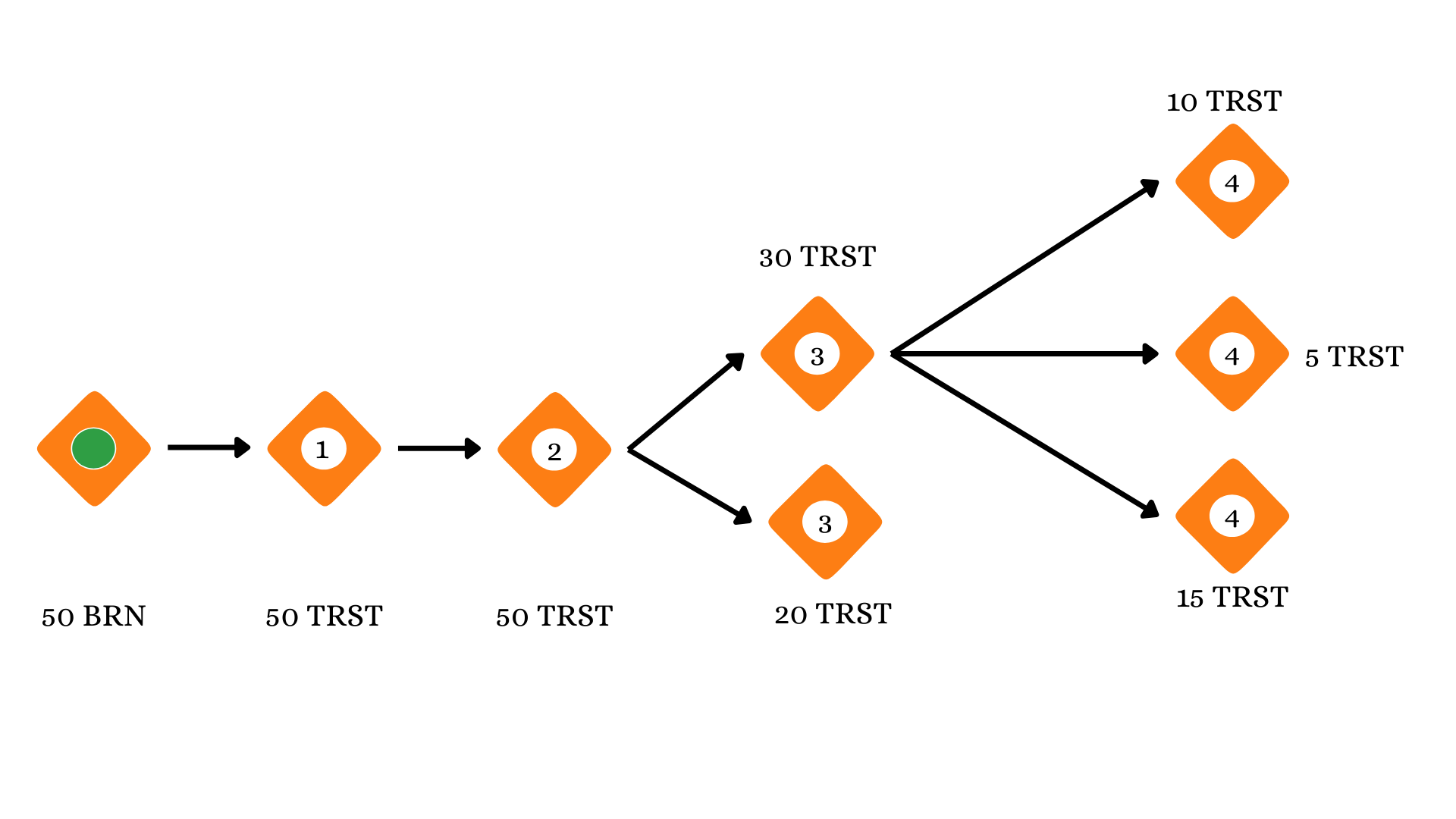
The amounts still add up to 50. Each part keeps a record of where it came from, so the network can connect it to the original BRN burn. The numbers inside the shapes show successive steps in this example, not separate new currency issues.
That history matters for two things: how old the TRST is, and what happens if its original creator is later found to have obtained verification fraudulently.
Expiry
TRST has a 70-year lifetime by default, measured as 70 periods of 365 days from its effective origin time. Once that time has passed, it becomes unspendable, whoever holds it. Passing it to another account does not restart its age.
The community can change this duration through governance. Examples elsewhere that use shorter lifetimes illustrate those alternative settings.
Expiry applies to TRST, not unused BRN. A person can keep their personal allowance until they need it; the currency created when they spend that allowance can have a limited period of circulation.
The amount does not gradually shrink. A holding of 50 TRST remains 50 TRST until expiry makes it unspendable. Wallets can show an age-based reference value, but people still choose the price at which they will accept it.
An expired holding remains recorded. If the governed lifetime later increases, its age may fall within the new limit and it can become spendable again. Fraud revocation is a separate condition, explained below.
Merging TRST
A wallet can receive many small holdings. Merging combines compatible holdings into one larger amount so they are easier to use together.
The merged amount is the sum of its inputs. Its expiry is the earliest expiry among them. Otherwise, someone could keep old currency alive by repeatedly mixing it with newer currency.
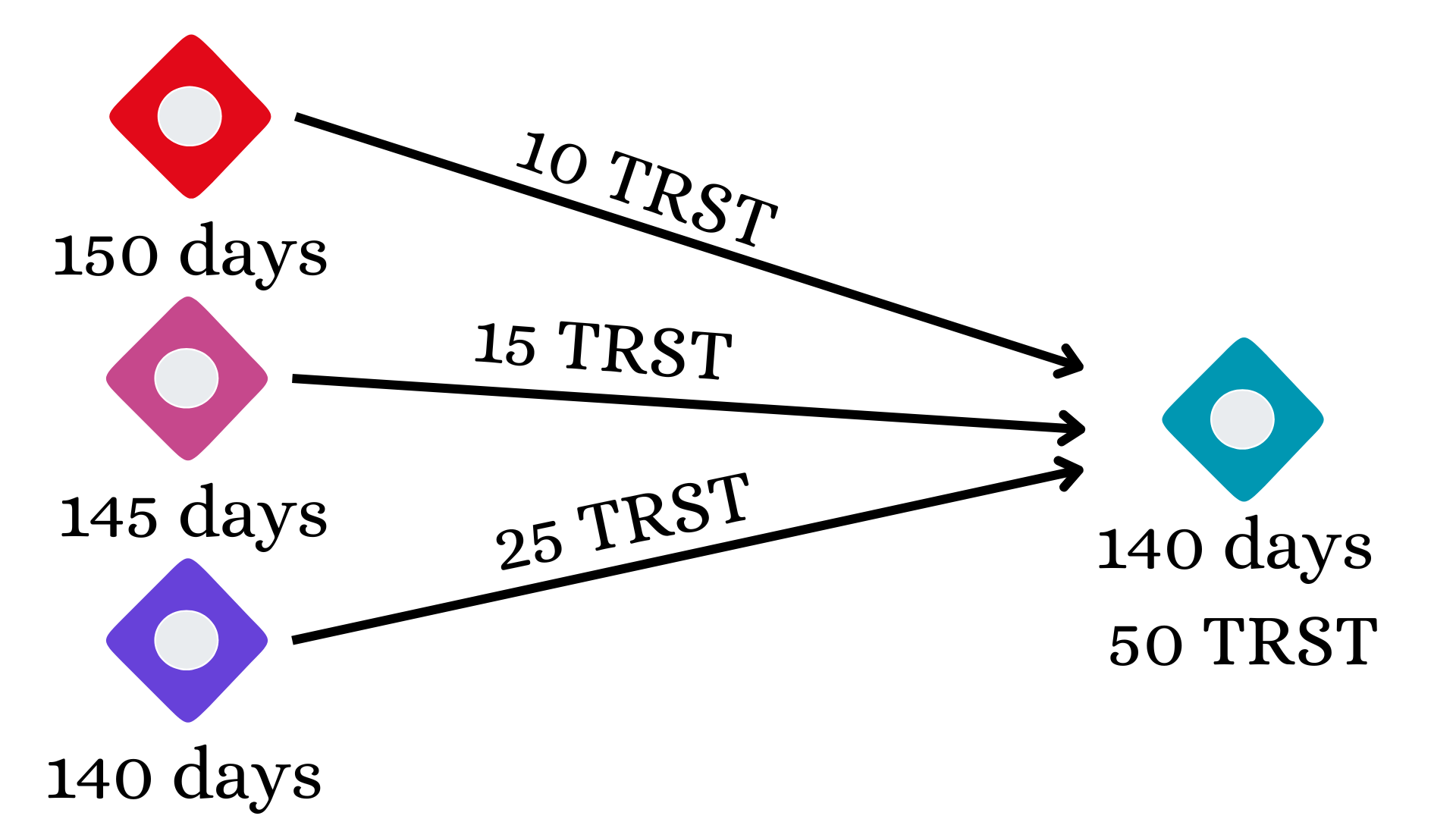
Here, 10 + 15 + 25 becomes 50 TRST, with 140 days remaining. Grouping holdings with similar lifetimes avoids sacrificing much of the newer inputs' remaining time. The wallet can make that selection automatically.
Merging also keeps the history of the inputs. Nodes store a merger graph: each merge points to the holdings it consumed. Another merge can refer to that result without copying the whole history into every payment.
The current operation accepts up to 256 inputs. Active and expired holdings cannot be mixed, and revoked value cannot be merged. Those rules keep consolidation from making unusable value spendable.
Revocation and restoration
What if the creator of some TRST passed verification using a false identity? Once a fraud challenge succeeds, the protocol revokes the value originating from that account. Its history lets nodes find the affected contributions even after they have been transferred, split or merged.
Consider the same 50-TRST merge. If its 10-TRST input came from the fraudulent account, one fifth of the mixture is affected. A later 10-TRST portion contains 2 affected TRST and 8 unaffected TRST. A 20-TRST portion contains 4 affected and 16 unaffected.
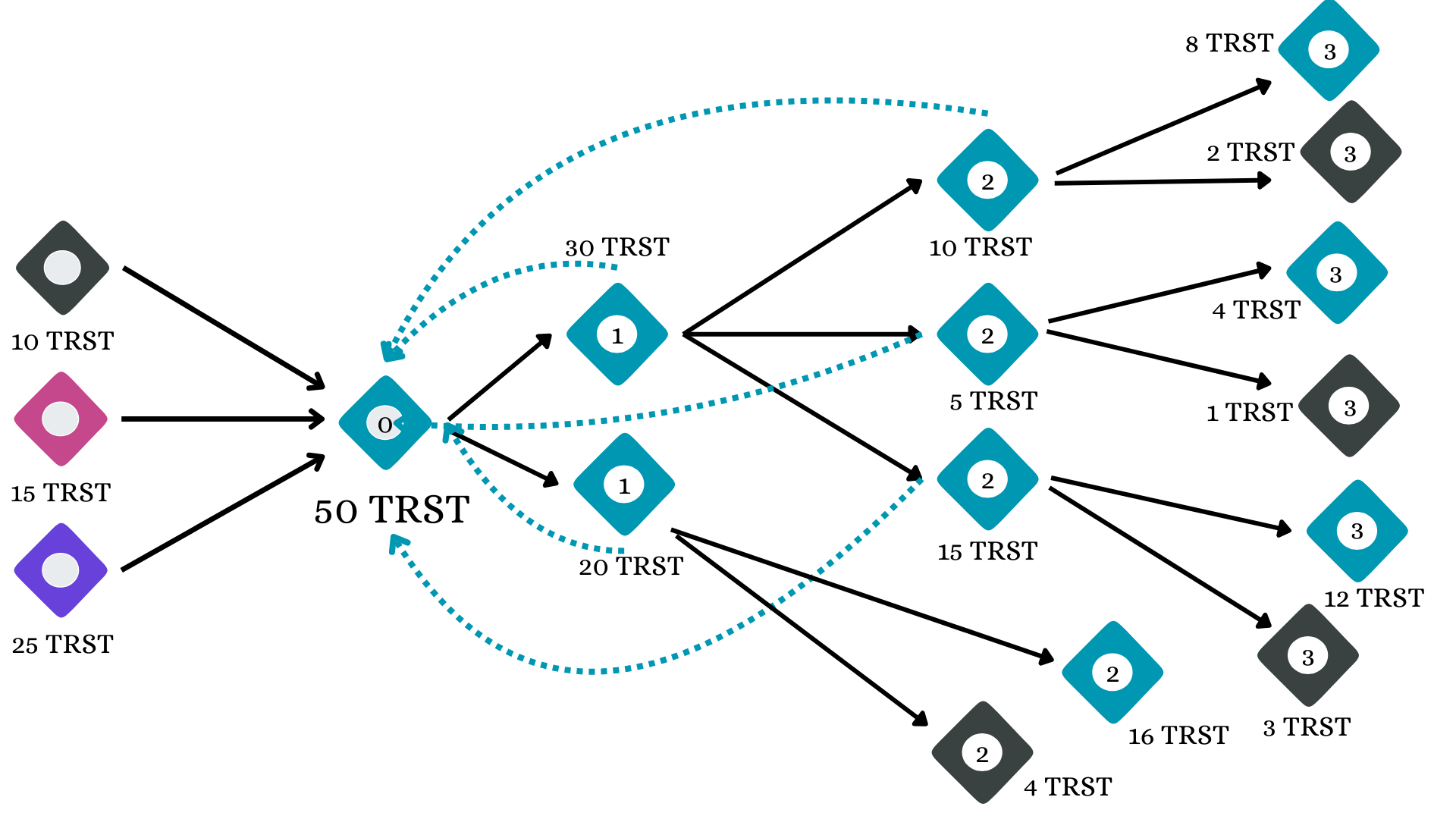
The dark portions show the revoked value. The other contributions remain usable, subject to their age. The network records the separation so a later payment or merge uses the value the holder actually has left.
If the origin is restored after re-verification, its separated value can become valid again. It does not get inserted into a newer merge that consumed only the unaffected remainder. This worked example shows that case in detail.
Revocation can therefore affect an honest recipient. It cannot recover goods already delivered to a fraudulent payer. Knowing the origin of a payment helps people assess that risk; it does not remove it.
Humanity verification
Equal income and equal voting weight depend on people being unable to enroll unlimited identities. BURST uses endorsements and selected verifier panels to make that judgment.
An applicant receives endorsements from verified accounts. Endorsers burn BRN to support the application. Once the requirement is met, the network selects a panel from eligible people who have volunteered to verify others.
The panel examines evidence and votes Legitimate, Illegitimate or Neither. Substantive votes require a stake. Neither needs no stake and does not count toward acceptance. Missing votes become Neither at the deadline. The protocol defines how much support is needed, whether another panel is tried, and how stakes are returned or forfeited.
The default panel has 7 members and requires 90% Legitimate votes. For example, with seven members and a 90% threshold, six votes are only about 85.7%, so all seven must support acceptance. These requirements are governable.
Panel selection must be reproducible. Nodes agree on the eligible pool before using a designated future randomness result from drand. Every node then uses the same inputs to select the same panel.
People assess the evidence; software records and applies their votes. The protocol does not supply an automatic biometric or identity-document check. The verification guide covers selection requirements, voting, stakes and deadlines.
Challenges and appeals
Verification has no scheduled renewal date. Another eligible participant can challenge an account under the protocol's rules, putting up the required stake. Submitting a challenge starts a review; it does not immediately revoke the target.
A successful fraud challenge removes verified rights and revokes the account's TRST origins. An inactivity outcome deactivates the account without revoking its earlier TRST. Both stop new BRN accrual while the account is inactive.
Re-verification can restore eligibility without awarding income for the inactive period. An appeal reviews an earlier challenge judgment. These processes can correct decisions, but still depend on the people judging them.
Optional trust policies
A recipient can choose stricter automatic acceptance rules in their wallet. They may trust particular original creators, or require those creators to belong to selected groups. Groups provide membership services outside the protocol.
If Bob sends Alice's TRST to Carol, a creator policy checks Alice. A sender allow-list checks Bob. These answer different questions. Neither changes the network's rules; a payment held for review can still be received manually. See acceptance policies.
Agreement between nodes
A wallet holds the account's keys and signs its actions. Nodes check those actions and maintain the ledger. Each account has its own chain of blocks, and a receive connects its chain to the payment it claims.
If two blocks try to follow the same predecessor, representatives vote on which one to confirm. Each verified account gives one equal unit of weight to its chosen representative. Holding more BRN or TRST adds no voting weight.
Some decisions affect many accounts at once: a verification result, a change to the income rate, or the set of representatives. Nodes use checkpoints to agree on the account history and shared state at those boundaries. They check the representatives' signatures and calculate the resulting state from the agreed history.
Representatives need enough voting weight online to make progress. Their saved signing history also matters: restarting a node must not let it sign a conflicting promise. Consensus and checkpoints explain these mechanisms.
Time and deadlines
Time determines BRN accrual and, where enabled, TRST expiry. It also sets the windows for voting and selection. Nodes use clock estimates for local checks and agreed checkpoints for shared deadline effects.
Representative checkpoint signing uses authenticated external time sources. Random panel selection uses a separately verified drand result. If the required time or randomness is unavailable, the affected work waits; the node cannot invent a replacement result. See node time configuration.
Governance
The community chooses the income rate and currency lifetime through verified-account voting. The same process governs supported verification and governance settings. A representative chosen to confirm payments does not automatically receive your governance vote.
An ordinary proposal gathers endorsements, enters voting, and must meet both participation and approval thresholds. Abstaining counts toward participation without supporting approval. An approved change waits through a cooldown before activation. Emergency proposals use a shorter path with higher voting requirements.
A rate change affects income from that point onward. Previously earned BRN keeps the rates that applied when it accrued. A lifetime change changes how old TRST may be while remaining spendable.
The protocol also supports constitutional text and scoped voting delegation. Constitutional text records the community's rules; executable changes still require software that implements them. Governance and the parameter reference describe the supported changes.
The first participants
A new network begins without enough ordinary verifiers. During bootstrap, the creator can endorse people through a special verification path. These endorsements still consume BRN.
The creator can also veto an approved governance proposal before it activates. Otherwise, activation needs no separate creator approval. These special powers end permanently at the bootstrap threshold, capped at 50 verified accounts including the creator. A later fall in population does not bring them back. See bootstrap permissions.
Economic choices
The two central parameters make different choices possible. A positive income rate supplies personal spending allowances. A finite TRST lifetime limits how long issued currency circulates. An unlimited lifetime lets it remain transferable regardless of age. A zero income rate stops new accrual.
These settings affect issuance and circulation. Prices still depend on what people offer and accept. Unspent BRN also matters: people can turn accumulated allowances into new TRST later, so the current income rate alone does not determine how much TRST enters circulation today.
BURST makes these choices part of the community's monetary rules. Whether those rules produce a useful economy depends on participation, reliable verification, goods and services, and decisions made through governance.
Wallets, nodes and history
A recovery phrase restores an account's key. The wallet reads its balances and verification state from the network. Saved signed actions need separate recovery handling if their outcome is uncertain; a lost response does not mean a payment failed.
Nodes retain the state needed to check payments, including holdings, pending receipts and merge history. Expired value can still matter for restoration or a future lifetime change. An authenticated snapshot can help recover state, but keeping only the latest block of each account is insufficient.
The ledger is public. Addresses do not contain people's names, but activity and external information can connect an address to a person. See wallet recovery, node storage and privacy.
Cryptography and upgrades
Accounts use Ed25519 signatures. Hashing and proof of work use Blake2b. Proof of work supplies an anti-spam computation cost; it does not mine currency or give the worker voting weight.
Changing these algorithms or introducing new executable rules requires a software upgrade. Parameter votes and epoch markers do not install code. The cryptography reference documents the formats.
Implementation status
The current source enables certified verifier selection, governance and appeals only on experimental Dev/Test builds. They are not currently enabled on Live. Physical deletion of historical block bodies is also release-gated. The availability table records these restrictions.
The accounting can be checked in code and tests. Verification quality, resistance to collusion and the behavior of a real economy also need observation and independent review. The limitations explain those assumptions.
For implementation work, start with accounts and blocks, RPC, or build and test. The architecture guide maps those mechanisms to code.